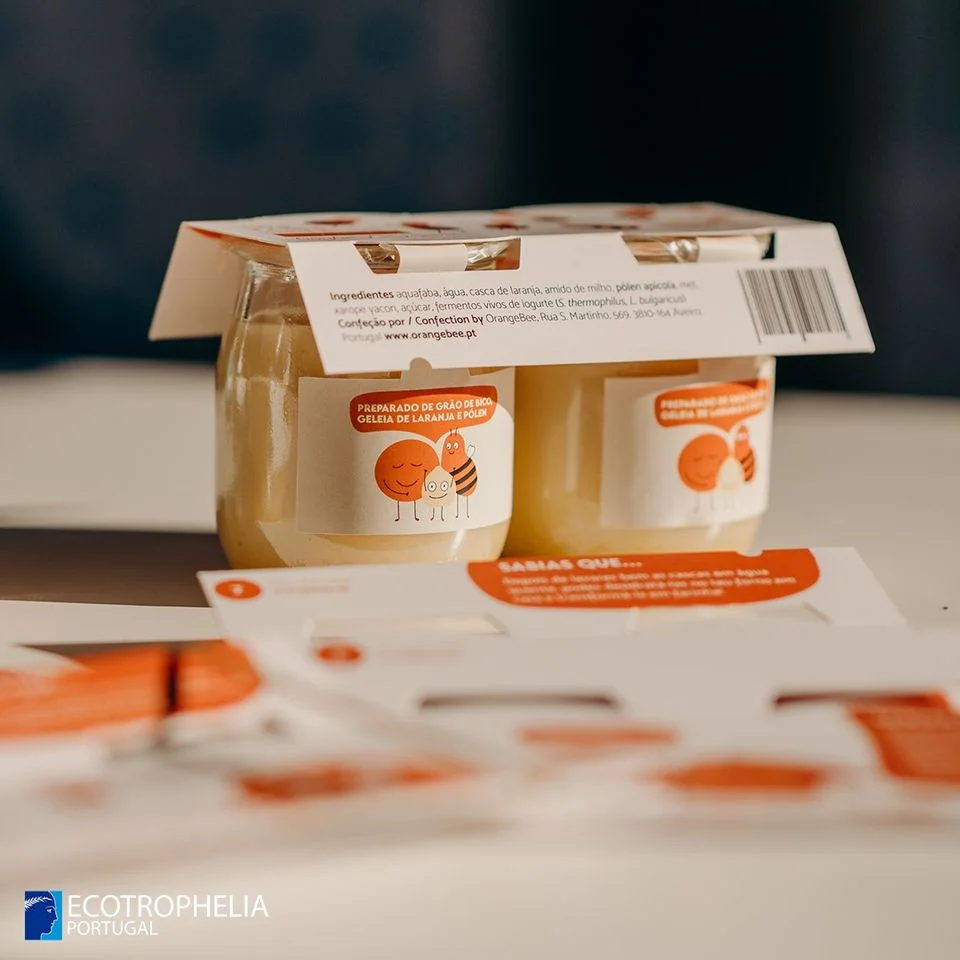
The OrangeBee project, a food preparation based on aquafaba and bee pollen that reuses waste from the food industry, was the big winner of the competition that brought together university students from 13 European countries. In its fourth participation in the Ecotrophelia Europe initiative, Portugal won first prize in what is the largest European competition in food eco-innovation.
 Developed by Bárbara Vitoriano and Adelaide Olim, master's students in biotechnology and design, respectively, at the University of Aveiro, OrangeBee is a fermented aquafaba preparation (water resulting from the cooking of legumes) with a layer of orange jelly, sprinkled with bee pollen. This food product, which can be used, for example, as a dessert, and which reuses waste discarded by the food industry, was awarded a prize by the European jury led by Nestlé.The OrangeBee product has a very appealing design, high quality, and a strong value proposition. It is an excellent contribution to the future of food innovation.”, says Christoph Hartmann, Head of Academic Alliances at Nestlé.
Fighting waste
The winners of Ecotrophelia Europe believe that this product fits into a perspective of combating waste. “ As committed citizens, we know that the choices we make as consumers are crucial for society, its quality of life, and its future. Since the fight against waste is a central pillar of sustainability policies, it seemed to us that developing a food product based on aquafaba, yacon, and orange peel, sprinkled with bee pollen, vegetarian, gluten-free, and lactose-free, would clearly meet the growing concerns of consumers and the trends in this sector. This distinction, at the European level, shows that our work and vision are on the right track .”
According to the project's mentors, OrangeBee is fat-free and a source of fiber, with 89 kilocalories per serving, providing 8% of the recommended daily intake of vitamin C and 21% of the daily intake of FOS, an important prebiotic in regulating intestinal transit. Due to the presence of bee pollen, considered a functional food, the consumer also obtains a considerable amount of antioxidant vitamins and flavonoids, essential in protecting the body against external aggressions.
Echotrophelia
OrangeBee was the eco-innovative project that represented Portugal and won first prize, among the 13 countries in competition and the 14 European universities present. The projects developed by student teams from Greece and Iceland secured second and third places, respectively: the O-live project, which developed breadsticks based on olive oil and with different fillings of Greek vegetables and fruits, and the Frosti project, which presented a lactose-free skyr flake solution.
This was the fourth time Portugal participated in the Ecotrophelia Europe initiative, whose Portuguese edition has been promoted by PortugalFoods since 2017. Last September, OrangeBee stood out in the national competition, which included 16 teams and involved 63 students and 14 higher education institutions. “ The European distinction for this Portuguese project couldn't fill us with more pride. The Portuguese agri-food sector has long been known in international markets for its quality and excellence. The fact that it is showing itself as an increasingly innovative industry, attentive to trends and new consumption patterns that place sustainability at the top of the agenda, will certainly help in promoting the agri-food sector abroad ,” says Deolinda Silva, executive director of PortugalFoods. “ On the other hand, this award is also recognition of the effort the sector has made to get closer to universities and centers of knowledge and innovation. Without a doubt, this strengthening of relations is a guarantee that the national agri-food sector is preparing for its future . ”