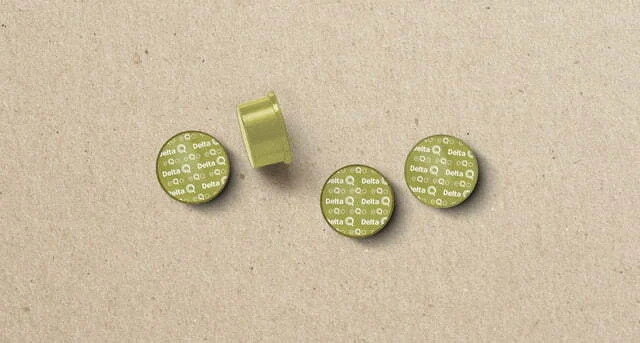
The Nabeiro Group shared its sustainability strategy until 2025 this Wednesday, May 15th, which includes several commitments in the economic, social and environmental areas.
In this context, the new Delta Q coffee capsule, 100% organic and biodegradable, was presented. A new capsule with 0% plastics, 0% microplastics and 0% aluminum, of organic and biodegradable origin made from BioPBS, that is, a bio-based and plant-based material, consisting of sugar cane, cassava and corn.
Developed by the Nabeiro Group's Innovation Center, Diverge, in conjunction with external partners and national research centers, the brand's first blend with this 100% organic capsule, Delta Q eQo, will be launched in the second half of the year, will have a shelf life of 90 days (due to its biodegradability), and will have triple sustainability certification. Specifically, Rainforest Alliance certification, which works to conserve biodiversity and ensure sustainable livelihoods through the transformation of land use practices, business practices, and consumer behavior; UTZ certification, representing sustainable agriculture and better opportunities for farmers, their families, and the planet; and finally, organic certification, whose method combines environmental practices that contribute to increased biodiversity and the preservation of natural resources.
The packaging for the new Delta Q eQo is made from fully recyclable cardboard, with FSC (Forest Stewardship Council) certification, which ensures that the product comes from a sustainably managed forest, and printed with bio-based inks.
Without a concrete date for their effective introduction to the market, these biodegradable capsules will be more expensive than conventional Delta Q capsules, and “ Delta will not pass on the entire increase in production costs to the consumer .” Intended for the national market due to the constraints imposed by the short shelf life of only 90 days, the new Delta Q capsules also require a rethinking of logistics, given the specific nature of this product. “ These capsules will have to be treated almost like a perishable product ,” explains Rui Miguel Nabeiro, administrator of the Nabeiro/Delta Cafés Group.
The manager emphasizes that “ the path to sustainability is a priority for the group and all its brands. With these initiatives, we continue the work we have been developing in the social area and for the benefit of the community. We intend to continue playing an active role in building value for society, contributing to the adoption of more responsible behaviors, while simultaneously adding value to the various moments of consumption and sharing provided by coffee .”
Two and a half years of work are behind us, but the " investment is not yet finished ," particularly because the company is committed to promoting the use of other biodegradable materials that will allow for a longer commercial lifespan for Delta Q capsules. This is because the goal is for " 100% of its capsules to be in this format " by 2025.
100% Portuguese coffee
In parallel, the company signed a cooperation agreement with the Azorean Coffee Producers Association – APAC, with a view to supporting all stages of the production, preparation and marketing of Azorean coffee over the next 15 years.
Following two joint field missions, carried out during 2018 and last April, it was possible to ascertain that, given the unique characteristics of the Azores archipelago, the successful cultivation of specialty coffee is viable, thus bringing economic value to local communities and helping to diversify crops, which are still very dependent on cattle farming (meat and milk).
With the signing of this protocol, Delta Cafés will support APAC members in all phases of coffee production: from the introduction of new competitive and economically viable coffee varieties, through technical advice and marketing support, to the development of a strategic plan for the entire coffee production chain, promoting a profitable socio-economic sector and successfully producing the only coffee in Europe. Currently, coffee production in the Azores is around nine tons, but Rui Miguel Nabeiro believes that this volume could increase significantly, with Delta Cafés taking over the purchase of local production. Confidence in marketing " 100% Portuguese " coffee exists, without a set date, but without losing its character as " the only coffee originating in Europe ".
The same awareness of the need to preserve the environment, and based on the principles of the circular economy, led the company from Campo Maior to develop a partnership with the start-up NÃM, in an innovative process of transforming coffee grounds into food, namely, mushrooms.
The "from waste to taste" concept, created in 2018 by Natan Jacquemin, founder of the startup, has a simple utilization method that begins when hot water, during the extraction of an espresso, passes through the coffee grounds, thus cleaning them. The coffee brewing process only uses 1% of its biomass, with the remaining 99% considered waste. These grounds represent a clean substrate rich in nutrients, an excellent food source for mushrooms.
Delta Cafés will collect coffee grounds from its customers using its own containers, maximizing operational efficiency through more sustainable production.
Goals until 2025
Since 1994, Delta Cafés has been committed to environmentally sustainable business practices. In this regard, it has defined a set of new goals in various areas of sustainable development by 2025, which are part of the growth strategy of the Nabeiro/Delta Cafés Group. In short, by 2025, the Portuguese group aims to ensure that its entire commercial vehicle fleet will consist of electric vehicles (currently, only 20%, 101 vehicles out of the more than 500 vehicles in the commercial fleet, are fully electrified).
Also by the same date, Delta Cafés aims for all its commercial departments in Portugal to be self-sufficient in electricity consumption through the installation of solar panels.
Following the market launch of Delta Q eQo, the company guarantees that it will continue to invest in research and development of better technical solutions and in the search for the most innovative materials so that, by 2025, the entire range of Delta Q blends can be sustainable. This is in addition to guaranteeing support for 500 coffee growers across all the islands of the Azores archipelago under the protocol established with APAC.