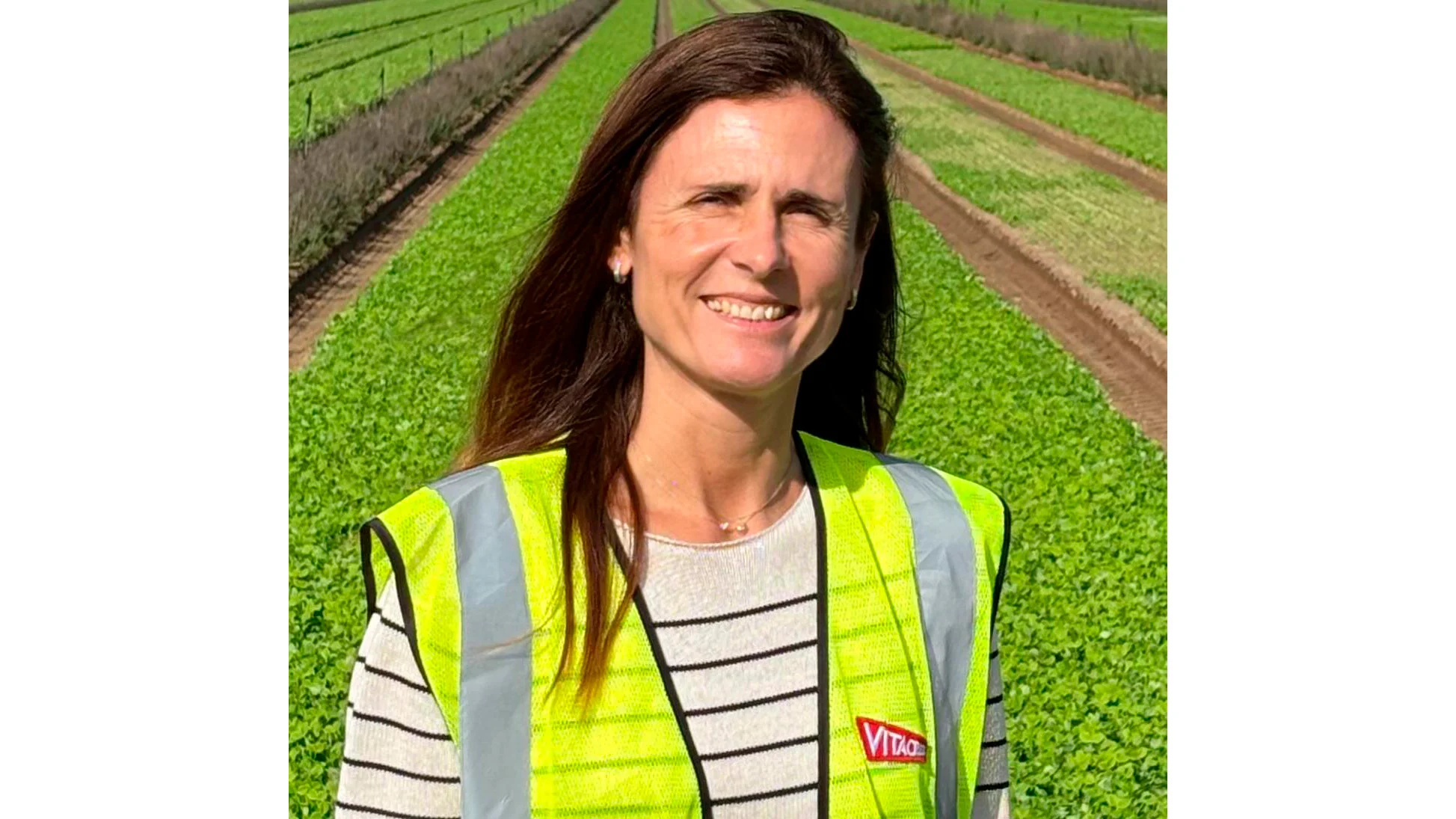
In a context where consumers are looking to eat healthier but have increasingly less time to cook, convenience plays a growing role in how fresh foods are chosen. It is within this framework that Vitacress has developed a new solution that allows fresh spinach to be cooked directly in its packaging, in the microwave, in just a few minutes, without losing its naturalness or versatility. In an interview, Sílvia Mendonça, business & customer development director at Vitacress, shares the insights that gave rise to the project, the challenges of its development, and the vision for the future of the fresh produce category.
How did the idea of developing fresh spinach ready to be steamed directly in the packaging come about? What consumer insights were at the origin of this project?
The idea arose from careful observation of the needs of the modern consumer. We identified two main trends: on the one hand, a growing desire for a more balanced and natural diet; on the other, an increasingly demanding lifestyle that values convenience and speed.
The fact that vegetable consumption in Portugal is below the recommended level, as indicated by the Portuguese Food Balance Sheet, served as motivation. We wanted to create a solution that would make consuming fresh vegetables easier and more accessible, eliminating barriers such as preparation time and lack of cooking skills.
This product is the direct answer to that challenge: the consumer places the package in the microwave and, in just five minutes, has the spinach ready, with less time, less effort and without compromising freshness, compared to traditional cooking which can take over 30 minutes.
What technical and operational challenges had to be overcome to ensure that the product maintains its freshness, food safety, and quality after microwave cooking?
The main challenge involved the packaging being able to cook spinach using microwave steaming without compromising freshness, nutritional value, food safety, or consistency of the result. This required a very rigorous selection of the materials used in the packaging and ensuring compliance with applicable European legislation for food contact materials, particularly regarding migration control. In the case of plastics, this compliance is assessed through global and specific migration tests under foreseeable usage conditions, including heating situations.
From a functional point of view, it was also necessary to develop packaging that could simultaneously preserve the product's freshness throughout its shelf life and ensure uniform cooking at the time of consumption. The packaging structure, its volumetric adjustment, and the micro-perforation system were designed to allow controlled ventilation and steam generation inside, guaranteeing a simple, safe, and consistent experience for the consumer.
Furthermore, this steaming method can help preserve nutritional quality compared to traditional boiling, precisely because it reduces direct contact with water and, consequently, the leaching of water-soluble vitamins.
How does this innovation differ from existing solutions, namely frozen vegetables or ready-made meals?
This innovation stands out, first and foremost, for combining the freshness of a ready-to-eat vegetable with the convenience of quick microwave preparation. It's fresh, baby- leaf spinach , ready to use, that retains all its usual versatility: it can be eaten raw, incorporated into a stir-fry, a soup, or other recipes, but it can also be steamed in its own packaging in just five minutes. This means it can function both as an ingredient and as a cooked side dish, simply and quickly. For example, in a recipe as common as eggs with spinach, what previously took about 30 minutes of cooking can now be done in just five minutes in the microwave, with the product perfectly cooked.
Compared to frozen vegetables, it stands out by remaining in the fresh produce segment, preserving the experience of a fresh product in terms of texture, flavor, and versatility. Compared to ready-made meals, the difference lies in not being a fixed dish, but a basic, natural, and versatile ingredient that the consumer adapts to different moments and recipes. In other words, it offers convenience without sacrificing freedom of use.
Ultimately, this product helps to make it easier to integrate vegetables into a balanced diet, even in routines with less time, less cooking experience, or less planning.
“Today, convenience no longer just means 'ready to eat'; it also means 'easy to prepare', 'easy to integrate', and 'easy to choose'. This evolution is particularly relevant in a category like vegetables, where practical barriers to frequent use still exist. Therefore, we believe that innovation in fresh produce largely involves responding to this need for simplification without compromising the perception of naturalness and quality.”
Convenience has been a driver of growth in the fresh produce category. How do you assess the evolution of this factor in the behavior of the Portuguese consumer?
Convenience has become an increasingly important criterion in purchasing decisions, including in the fresh produce category. Portuguese consumers continue to value quality, freshness, and reliability, but are increasingly seeking solutions that simplify meal preparation and adapt to the pace of daily life.
Today, convenience no longer just means "ready to eat"; it also means "easy to prepare," "easy to integrate," and "easy to choose." This evolution is particularly relevant in a category like vegetables, where practical barriers to frequent use still exist. Therefore, we believe that innovation in fresh produce largely involves responding to this need for simplification without compromising the perception of naturalness and quality.
This product aims to bring fresh produce closer to the ready-to-eat or ready-to-cook concept. Do you consider this to be the future of the category?
We believe this is a very important part of the category's future. Consumers will continue to look for fresh products, but with formats and functionalities that make them easier to use in everyday life.
In this sense, the ready-to-cook concept has enormous potential because it allows for added convenience without altering the product's character. It doesn't replace the essence of fresh produce; on the contrary, it makes it more accessible, simpler to use, and more present in everyday meals. More than a passing trend, we see this as a natural evolution of the category.
How do they balance convenience with the perception of naturalness and freshness, which remains central to the consumer?
This balance is achieved by ensuring that innovation serves the product and not the other way around. In this case, what changes is the functionality of the packaging and the ease of use; the product remains true to what the consumer expects from Vitacress fresh baby spinach.
We continue to talk about carefully selected baby leaves , with the same criteria for quality, freshness and versatility. The packaging does not alter the nature of the product; it only adds a simpler way to prepare it.
It is precisely this approach that allows us to reconcile convenience with naturalness: innovating in the user experience without distancing the product from what defines it.
What impact do you expect this innovation to have on how consumers incorporate fresh vegetables into their daily meals?
We hope this will make integration simpler, more frequent, and more spontaneous. When a fresh product can be prepared quickly, easily, and without complexity, it reduces a significant portion of the barriers that often keep consumers away from vegetables.
Do you believe that this type of solution can increase the penetration of the fresh produce category among consumers less accustomed to cooking?
Yes, we believe it can have that effect. For consumers with less cooking experience, less time, or less confidence, ease of use is a decisive factor. By offering a fresh, ready-to-use, and easy-to-prepare solution, we are bridging the gap between the intention to eat better and the practical ability to do so on a daily basis. This can be especially relevant for audiences who would otherwise tend to opt for more processed or less versatile solutions. In this sense, this type of innovation can act as a gateway to greater consumption of fresh produce.
What opportunities does this product offer to retailers, particularly in terms of shelf differentiation and value creation?
This presents a clear opportunity for differentiation within the fresh produce category itself, by introducing a new functionality to a product that consumers already know and value. This allows for enriching the shelf offering with a proposition that responds very concretely to current convenience needs.
For retailers, this can translate into greater category relevance, a greater ability to capture attention at the point of sale, and the potential to create value through more innovative and user-oriented solutions.
How does this solution contribute to reducing food waste, both at home and throughout the value chain?
This solution can contribute to reducing waste by making the product easier to use and helping consumers integrate it more easily into their daily meals. The simpler it is to use a fresh vegetable, the greater the likelihood that it will actually be consumed.
At the same time, the packaging was designed to better preserve the product's freshness, which also helps protect its quality throughout the supply chain and in the consumer's home.
“By offering a fresh, ready-to-use, and easy-to-prepare solution, we are bridging the gap between the intention to eat better and the practical ability to do so on a daily basis. This can be especially relevant to audiences who would otherwise tend to opt for more processed or less versatile solutions. In this sense, this type of innovation can act as a gateway to greater consumption of fresh produce.”
Packaging plays a central role here. What environmental concerns were considered in its development?
Sustainability is a central concern for Vitacress. In the design of this packaging, alongside functionality and food safety, the environmental dimension was a fundamental criterion. We continuously seek to optimize our packaging to reduce its weight and incorporate materials that facilitate recycling, aligned with our global sustainability strategy and the goals of the circular economy.
How does this launch fit into Vitacress's innovation strategy for the 4th range?
This launch is a natural and strategic step in our leadership in the fourth range, as it reinforces our presence in the segment of ready-to-eat and ready-to-cook fresh vegetables. Our strategy involves continuing to innovate, combining freshness, convenience and versatility to meet increasingly demanding lifestyles and consolidate our position as a benchmark brand in fresh food solutions.
What role has research and development of new solutions played in the brand's evolution in recent years?
Research and development have played a central role in the brand's evolution. They are fundamental in allowing us to anticipate needs, monitor changes in consumer behavior, and transform these insights into concrete solutions.
In the case of Vitacress, innovation doesn't just mean launching new products; it also means improving formats, processes, functionality, and user experience, always focusing on relevance and quality.
It is this ability to evolve consistently that has allowed the brand to continue to establish itself as a benchmark in the sector.
Can we expect more innovations in the "ready-to-cook" segment or even new categories within packaged fresh produce?
The ready-to-cook segment is an area we strongly believe in and that is fully aligned with what we have been developing at Vitacress. This year, in addition to Baby Spinach with microwave-safe packaging, we also launched Vitacress Broccoli with this feature, which demonstrates that this is not an isolated venture, but a path of innovation that we want to continue exploring.
Our ambition is to develop fresh solutions that make eating simpler, more practical, and more accessible, without compromising quality, freshness, or versatility. Whenever we identify opportunities to add real value to the category and better meet the daily needs of consumers, that will be an area where we want to continue to evolve.
“We envision a fresh produce section that is increasingly solution-oriented, but also more transparent, more responsible, and more connected to the origin of the products. In the future, consumers will seek not only convenience and ease of use, but also greater confidence about where what they buy comes from, how it was produced, and what impact it has along the value chain.”
How do they envision the fresh produce section in five to ten years, and what role does Vitacress intend to play in this transformation?
We envision a fresh produce section that is increasingly solution-oriented, but also more transparent, more responsible, and more connected to the origin of the products. In the future, consumers will seek not only convenience and ease of use, but also greater confidence about where their purchases come from, how they were produced, and what impact they have along the value chain.
We believe there will be a growing appreciation for more practical formats adapted to different consumption occasions, but without losing sight of pillars that will continue to be central: freshness, quality, sustainability, origin, and traceability. The shelf space will tend to evolve towards a more complete value proposition, in which the product is evaluated not only for what it is, but also for how it reaches the consumer.
Vitacress wants to play an active role in this transformation, leading innovation within the category in a balanced way: developing more convenient solutions, but also reinforcing production that is increasingly aligned with responsible practices. Our goal is to contribute to a more relevant, more informed, and closer-to-the-way product line that reflects how people live, choose, and consume.