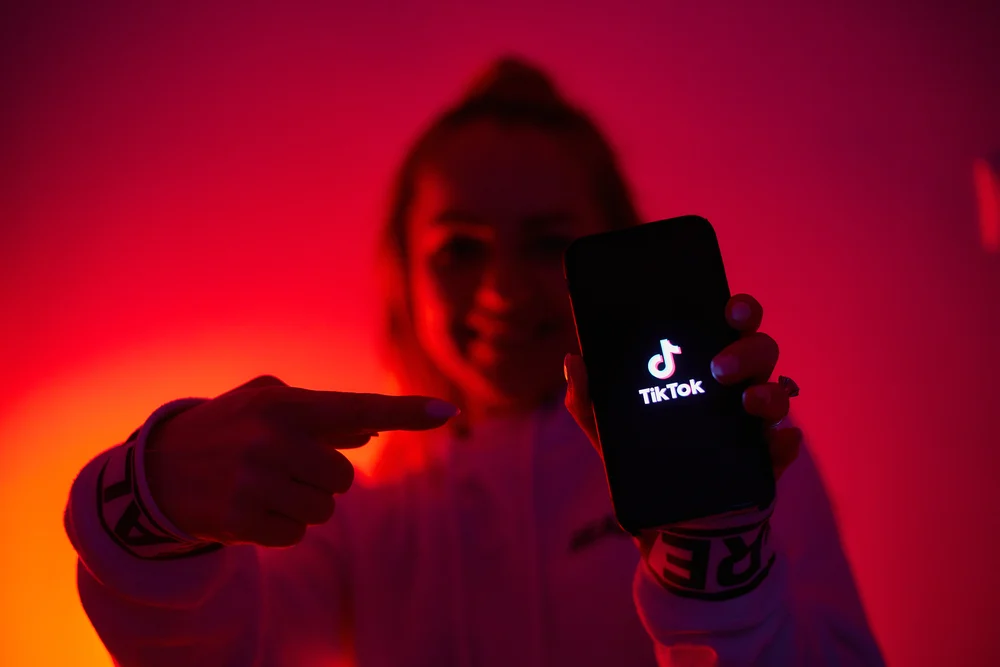
Trends on TikTok appear, expand, transform, and disappear at a rate that forces brands to rethink how they produce content and participate in the social conversation. According to a study by Publicis Groupe APAC and TikTok , almost half of the trends on the platform disappear within five days, and only 27% remain relevant for more than two weeks.
The report analyzed millions of data points across seven markets – Thailand, Indonesia, Vietnam, the United States, the United Kingdom, Germany, and Japan – based on daily monitoring of the top 200 TikTok hashtags in 16 categories over six months. The goal was to understand why some trends fade within a few days, while others manage to cross countries, be reinterpreted by different communities, and maintain relevance for weeks or months.
Longevity is worth more than initial virality.
The main conclusion of the study is that longevity, and not just initial virality, is the true indicator of impact. In a context where many brands continue to try to react to the most visible trend of the moment, the analysis by Publicis and TikTok suggests that strategic value lies in the ability to detect patterns of persistence: ideas capable of remaining relevant because they activate shared emotions, everyday behaviors, or simple codes that are easy to recognize and reuse.
The study thus distinguishes between trends that generate only a brief peak of attention and those that acquire a true cultural trajectory. The former often depend on a joke, a reaction, a news item, or a specific moment. They work while the context is alive, but have little room for reinterpretation.
Enduring trends operate differently. They are not always the most eye-catching, nor the fastest growing, but they are the most adaptable. According to the report, these trends are often based on shared human emotions, repeated behaviors, or simple creative structures that allow different users to create their own version. It is this capacity for community appropriation that multiplies the lifespan of a trend.
Usefulness and cultural codes prolong relevance.
The study identifies two main types of trends with a greater capacity to transcend two weeks of relevance. The first group is that of utility trends, based on advice, tricks, learnings, or practical formats that users replicate. The report cites the example of the Vietnamese hashtag #Meovat, which can be translated as "advice" or "tips" and functions as a kind of collective lesson, where creators share cleaning, cooking, or daily life tricks.
The second group corresponds to trends anchored in cultural codes or shared traditions. The study mentions #DanjiriFestival, linked to a centuries-old festival in Osaka, which found new life on TikTok through the way creators told the story. The festival wasn't new, but the narrative allowed a local expression to be transformed into discoverable content.
Southeast Asia functions as a cultural corridor.
One of the most relevant findings of the report concerns the geographical circulation of trends. Publicis and TikTok identify Southeast Asia as the most connected cultural corridor on the platform. Markets such as Thailand, Indonesia, and Vietnam share a high proportion of trending content, despite linguistic diversity.
According to the study, campaigns launched in a Southeast Asian market have a 60% to 70% chance of gaining traction in neighboring countries within a few days, provided the format has been designed to be reinterpreted.
For brands, the implication is significant: in some regions, culture no longer moves solely across national borders, but through clusters of behavior, humor, aesthetics, and platform usage.
Formats travel better than messages.
The report also underscores a central idea for marketing teams : on TikTok, formats travel better than messages. Trends built on clear visual models, adaptable sounds, transitions, or simple mechanics tend to expand and last longer than pieces that are too narrative or confined to a rigid verbal message.
The reason is simple: the easier it is to participate, the more likely a trend is to escalate. A transition, a sound, or a visual pattern allows each creator to adapt the idea to their context without having to reproduce the brand's original message exactly.
The study indicates that strong formats can sustain momentum for 60 to 150 days. This interpretation changes how effectiveness should be measured. Instead of looking only at impressions, views, or immediate reach, Publicis proposes observing the engagement gained: the ability of an idea to continue generating versions, remixes , and appropriations over weeks.
For brands, this calls into question the impulse to produce overly polished, closed, or controlled content. On TikTok, overproduction can work against engagement, especially when users realize that a brand has arrived late to a conversation or is trying to insert itself into a trend without understanding its logic.
Designers extend the life of trends.
Another central point of the study is the role of creators. Trends co-created with creators show higher remix rates and greater persistence than ideas launched unilaterally by brands. On TikTok, creators don't just function as amplification channels. They are interpreters of the platform's language, detectors of community codes, and agents capable of adapting an idea to a tone legitimate for their audience.
The findings point to a shift in mindset. Instead of chasing trends once they are visible, brands should develop systems to identify persistent signals before they peak. This implies investing in real-time listening, incorporating cultural reviews into weekly planning, and observing not only what grows, but also what is repeated, retained, adapted, and shared among communities.
Publicis proposes treating trend-sensing as an internal capability, equipped with dynamic dashboards , agile decision-making processes, and clear criteria to distinguish a passing fad from a cultural signal with potential.
On TikTok, the impact isn't necessarily in the trend that explodes the fastest, but in the one that continues to be recreated, reinterpreted, and shared long after the initial peak of visibility has passed.