Linde Material Handling (Linde MH) has presented its 2024 Sustainability Report, a document summarizing the company's key progress in the environmental, social, and governance areas. Among the highlighted results is the reduction of direct and indirect greenhouse gas emissions, reflecting a sustained strategy that combines energy efficiency, increasing use of renewable electricity, and optimization of production processes.
According to Linde , the reduction in emissions in 2024 was achieved through several structural measures, including the use of waste heat, improved energy efficiency of infrastructure, and the integration of more sustainable solutions in production. “ The consistent reduction in emissions results from continuous work that combines operational efficiency with strategic decisions regarding energy and production ,” emphasizes Bernhard van der Westhuizen, Director of HSE Sales and Services at Linde MH.
The report also highlights significant progress in environmental certification, with 99% of factories and sales and service units certified according to ISO 14001, compared to 94% in the previous year. In parallel, Life Cycle Assessments (LCA) play a central role in analyzing the environmental impact of forklifts and warehouse equipment, allowing for the evaluation of environmental performance throughout the entire product lifecycle. Developed in partnership with the Fraunhofer Institute, these assessments follow ISO 14040 and 14044 standards and already cover various ranges of industrial forklifts, including recently launched electric models.
Investing in the circular economy is another pillar of Linde MH's strategy. In collaboration with Li-Cycle Holdings Corp., the company sent approximately 15,8 tons of lithium-ion battery modules for recycling in 2024, corresponding to 442 batteries, allowing for the recovery of reusable materials in the manufacture of new energy solutions.
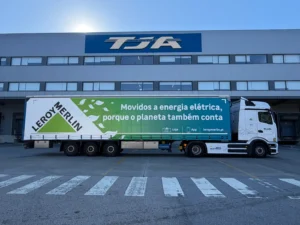
The report also anticipates new challenges and investments starting in 2026, with particular emphasis on the electrification of internal logistics. Linde MH plans to put into operation two 42-ton electric trucks, intended for transporting forklift counterweights on a 35-kilometer route between the production unit and the assembly plant in Aschaffenburg, Germany. In parallel, the Service Center will integrate ten new electric commercial vehicles, allowing for an estimated reduction of approximately 180 tons of CO₂ per year.
“ In a challenging economic context, it is essential to reconcile competitiveness with concrete environmental benefits. Sustainability is integrated from product design to logistics ,” reinforces Bernhard van der Westhuizen. Franz Huber, project manager for energy solutions at Linde MH, underlines that “ the acquisition of these vehicles represents a decisive step in the electrification of our internal logistics ,” also highlighting the support of German and European public programs promoting sustainable mobility in financing these investments.
Follow us on: