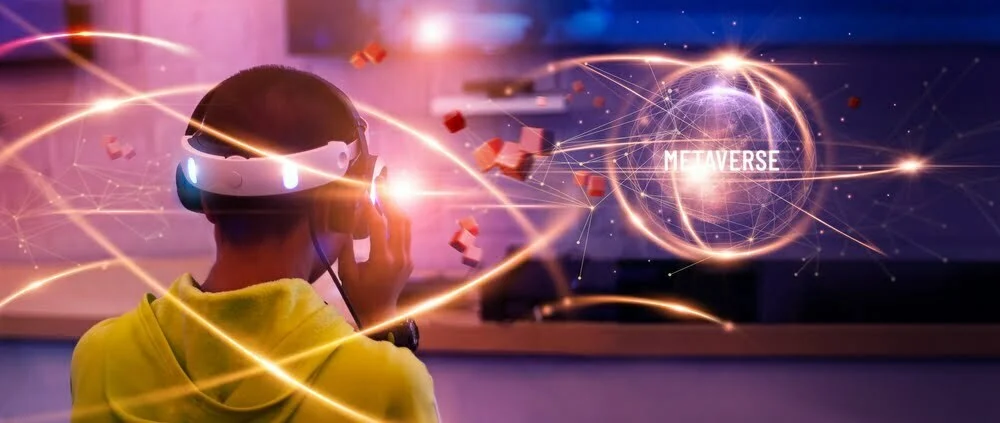
The latest edition of Accenture's "Consumer Pulse Survey" reveals that the increasing use of immersive technologies, such as augmented and virtual reality, is expected to encourage companies in the consumer goods, retail, and travel sectors to increase investment in new resources and experiences that allow them to combine the physical and virtual worlds. Those that fail to do so risk being left behind.
The Accenture study, which surveyed more than 11 consumers in 16 countries, shows that almost two-thirds (64%) of consumers have already purchased a digital good or participated in a virtual experience or service in the past year, numbers that are expected to increase, as 83% show interest in making purchases in the metaverse. Furthermore, 42% of respondents say they visited a retailer in the virtual world to get advice, make a payment, or browse a product line when buying a physical item, while 56% of respondents plan to do so in the coming year. Among Millennials, these numbers increase to 51% and 61%, respectively.
According to Accenture's Technology Vision 2022, "Meet Me in the Metaverse: The Continuum of Technology and Experience Reshaping Business," more than half (55%) of consumers agree that the places where they live and work are shifting to digital spaces. In response, the vast majority (90%) of retail executives anticipate that leading organizations will challenge the boundaries of the virtual world to make it more real, increasing the need for constant and seamless movement between the physical and digital worlds. Furthermore, 72% of executives state that the metaverse will have a positive impact on their organizations, with 45% believing it will be innovative or transformative.
Manuela Vaz, Vice President of Accenture, responsible for retail and consumer goods, states that “ the metaverse era has begun, and therefore, for companies in the consumer sectors, the question is not whether they will enter the metaverse, but how they will do it .” According to the manager, “ retailers and brands will need to rethink and create new immersive experiences for consumers. In addition to new sales opportunities, the metaverse can also help to build customer loyalty through experiences that go beyond simply buying a product. For example, retailers can create a personalized experience by offering a live shopping event where customers can sit next to a brand ambassador and then immediately enter a virtual fitting room to try something on, add it to their cart, and complete the purchase process .”
Lazer
The Accenture study also reveals that half (50%) of consumers admitted that they are buying, or are interested in buying, a travel experience, such as a sightseeing tour or a hotel stay, through the metaverse. This number rises to 55% for Millennials, compared to 29% for Baby Boomers. In the leisure experiences sector, 54% of consumers say they are buying, or interested in buying, tickets for a show or sporting event in a virtual world.
Emily Weiss, senior managing director at Accenture and global lead for travel, explains that “ it’s important to recognize that the metaverse isn’t meant to replace physical travel, but rather to complement a comprehensive experience that, over time, can become an essential part of the travel ecosystem. Offering the option to sit in a virtual first-class seat, experience the lounge, or stroll through a resort or hotel room opens up opportunities to truly engage and inspire people before they travel. And, through this concept of ‘experience before you travel,’ recreating past landmarks, or allowing travelers to discover parts of nature they can’t explore in real-life interaction, the metaverse can also help create a more meaningful travel experience that meets or even exceeds customer expectations .”
Retail
In addition to giving rise to new ways of shopping, traveling and socializing, virtual products and places highlight a potential opportunity to increase revenue across all sectors.
Oliver Wright, senior managing director at Accenture and global lead for consumer goods and services, states that “ in a world where digital has become as important as physical, companies are challenged to create, shape, and market products, services, and experiences that can move between the physical and virtual worlds. And this process must happen as they coordinate a network of experts, capabilities, and technologies that help make it possible. Although commercial applications of the metaverse are still in their early stages, they will develop rapidly in line with consumer expectations. Consumer brands capable of collaborating with consumers and the metaverse ecosystem to create digital products and services that meet emerging consumer needs will be the most successful in this new reality .”