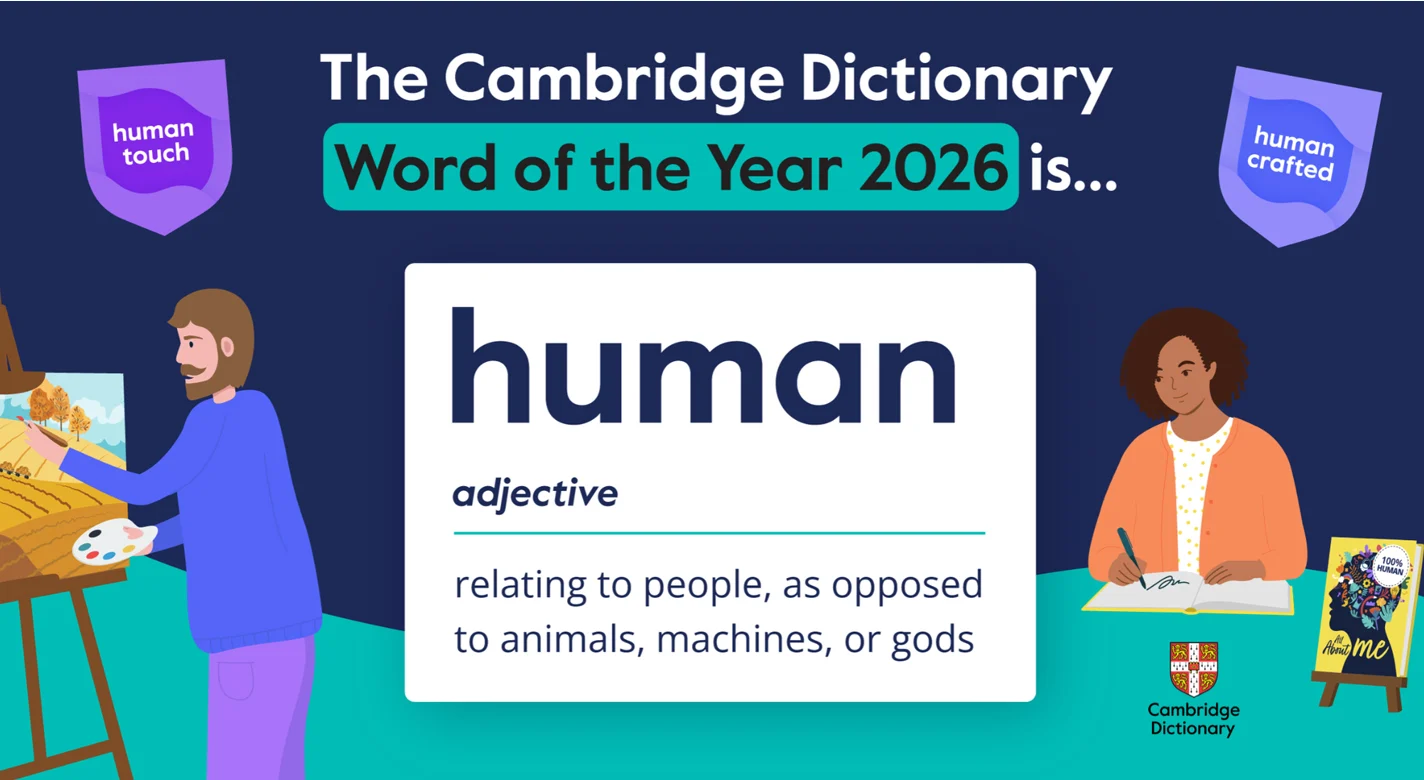
The Cambridge Dictionary has chosen "human" as the word of the year for 2026, a selection that reflects the transformations brought about by the expansion of artificial intelligence and the debate about what distinguishes people from machines.
The decision, announced on November 17 by Cambridge University Press & Assessment, comes at a time when advances in artificial intelligence are altering work processes, content creation, and consumers' relationship with technology.
According to the British dictionary, the term "human" is used to identify the qualities, characteristics, imperfections, and emotions inherent in people, as opposed to animals, deities, or machines.
The choice aims to capture a shift in how society uses language to distinguish what is produced, decided, or developed by people from what results from automated systems.
Artificial intelligence reinforces the importance of human intervention.
The Cambridge Dictionary has identified a growing interest in expressions that highlight the human origin of content, products, and activities. Examples include " human-made ," "human-written," and "human-generated ," used to identify creations made by people as opposed to those produced by artificial intelligence.
This evolution reflects a shift in the very function of the word "human," which is now being used more frequently to distinguish between human work and the output of technological systems.
Colin McIntosh, lexicographer for the Cambridge Dictionary, believes that artificial intelligence is transforming how society talks about the human condition. According to him, the fear of losing certain capabilities as tasks are delegated to artificial intelligence systems has led different sectors to reassess the importance of human thought, creativity, and intervention. The institution considers this renewed appreciation of the human factor to be one of the defining elements of 2026.
Creativity and authenticity at the heart of the debate.
The choice comes in the context of growing discussion about the use of human-created content in the development of artificial intelligence systems. Throughout 2026, various professionals in the creative industries have expressed concerns related to the unauthorized reproduction of images and voices, the use of copyrighted works, and the replacement of human work with automatically generated content.
Among the personalities who participated in this debate were actors, musicians, and writers such as Scarlett Johansson, Cate Blanchett, Billie Eilish, Jodi Picoult, and Jonathan Franzen.
Initiatives such as the Human Artistry Campaign and the Artists Rights Alliance have advocated for greater protection of creators' rights and clearer rules for the use of works in training artificial intelligence models.
The debate also extends to identifying the origin of the content. The Authors Guild, an American association of writers, launched the Human Authored initiative, aimed at distinguishing books written by human authors.
These initiatives reflect a growing concern for transparency and authenticity in a digital environment where the automated production of content has become more accessible.
"Agent" and "analog" are among the other words considered.
Artificial intelligence was also present on the list of other words considered by the Cambridge Dictionary for the 2026 distinction. One of them was "agent," a term used to designate artificial intelligence systems capable of performing complex tasks and making certain decisions without continuous human intervention.
Another term was "analog," associated with activities and experiences that do not depend on the internet or digital technology. The growing interest in lifestyles less dependent on screens, including activities such as reading physical books, crafts, and using vinyl records, contributed to the relevance of this term.
The word "wholesome ," related to experiences or behaviors considered positive for well-being, was also included in the selection.
The dictionary is also tracking the use of FOBO , an acronym for fear of becoming obsolete , an expression that describes the fear of losing professional relevance or employment due to the automation of tasks by artificial intelligence.
The human value in an increasingly automated society.
The choice of "human" as word of the year reflects a debate that goes beyond linguistic and technological issues. The increasing integration of artificial intelligence in education, science, communication, and business is raising new questions about responsibility for decisions, trust in content, and the skills that should remain associated with people.
Rachel Adams, a specialist in artificial intelligence governance and human rights at the University of Cambridge, believes that technology is bringing back fundamental questions about human identity and the values that society seeks to preserve. The researcher acknowledges the potential of artificial intelligence to contribute to scientific and economic advancements, but also warns of the risk of deepening inequalities.
In turn, Bill Gates, president of the Gates Foundation, believes that the evolution of artificial intelligence should be evaluated by its ability to improve people's lives, advocating for deliberate decisions about the areas in which human intervention should continue to play a central role.
Brands and companies face new trust challenges.
The increased value placed on the human origin of content may also have implications for the communication strategies of companies and brands. As artificial intelligence assumes a growing role in the production of texts, images, advertising campaigns, and digital experiences, identifying human intervention could become a differentiating factor.
Authenticity, transparency, and trust are particularly important issues for brands seeking to establish lasting relationships with consumers.
However, the choice of word of the year does not, in itself, demonstrate that consumers are willing to pay more for products or content created by people. It primarily represents a sign of the growing cultural and linguistic importance attributed to the distinction between human creation and automated production.
Advertise with us!