Errors between orders placed and received have become the main concern for retailers in Portugal, surpassing even meeting delivery deadlines and signaling a new phase of demanding standards in value chain management.
This is one of the main conclusions of the 14th edition of the GS1 Portugal Supply Chain Benchmarking, which assessed the efficiency, based on 2025 performance, of eight major retail brands and thirty of the main suppliers operating in Portugal.
Developed for the first time with a forward-looking component in partnership with ISCTE Executive Education, the study shows that companies are shifting their focus from speed to precision, predictability, and collaboration, in a context marked by increasingly complex supply chains that depend on information sharing.
“The results show that the competitiveness of the supply chain no longer depends solely on delivery. Today, the ability to reduce errors, share information and collaborate effectively between partners has become a critical performance factor for the entire value chain,” says Paulo Gomes, general manager of GS1 Portugal.
SIA and Pingo Doce lead the rankings.
In the global ranking of suppliers, the Industrial Society of Appetizers (SIA) achieved first place, followed by Gallo, Pescanova, SumolCompal and Matudis.
On the retail side, Pingo Doce led the overall ranking assigned by suppliers, followed by MC Sonae. The overall performance of retailers showed positive growth, with the maximum score rising from 6,89 to 7,29 and the overall average increasing from 5,71 to 5,99.
Less tolerance for error
This year's edition highlights a general increase in retail demands regarding supplier performance. Eliminating discrepancies between orders received and requested emerges as the sector's top priority, while simultaneously receiving one of the lowest supplier ratings, revealing a clear opportunity for operational improvement.
The study also identifies a significant shift in partner relationships. Building strong relationships between logistics, supply chain, and customer service teams has moved from 16th to 2nd place among retail priorities, demonstrating that collaboration is now seen as just as important as traditional operational indicators.
Among the remaining priorities are compliance with product validity requirements, cold chain control, promotional execution, and the ability of suppliers to respond quickly to changes and unforeseen events. Conversely, compliance with lead time, which held first place in the previous edition of the study, has dropped to 7th position.
Suppliers want more efficiency in retail.
In the evaluation carried out by the suppliers, the main concerns continue to focus on the efficiency of the reception and administrative processing.
Speed and efficiency in unloading goods, reduced waiting times at warehouses, and expedited invoice processing are among the top priorities identified. Suppliers also value better coordination of delivery schedules, allowing for load consolidation and improved transport optimization.
The increasing importance attributed to the automation of EDI messages and data alignment also demonstrates that digitization continues to play a central role in improving value chain efficiency.
AI, 2D code, and collaboration are shaping the future.
The prospective analysis carried out in partnership with ISCTE Executive Education identifies five major trends that are expected to shape the evolution of the supply chain in the coming years: greater end-to-end visibility of operations, increasing use of Artificial Intelligence, widespread adoption of GS1 global standards, strengthening of sustainability practices, and development of strategic collaboration models between retailers and suppliers.
Among the highlighted themes are preparation for the new generation of GS1 two-dimensional codes, the expansion of EDI messages (DESADV and RECADV), articulating with circular sustainability practices such as backhauling, reusable packaging and the Deposit and Refund (SDR) system, and with strategic collaboration models (Joint Value Creation) focused on shared metrics such as OTIF and cost-to-serve.
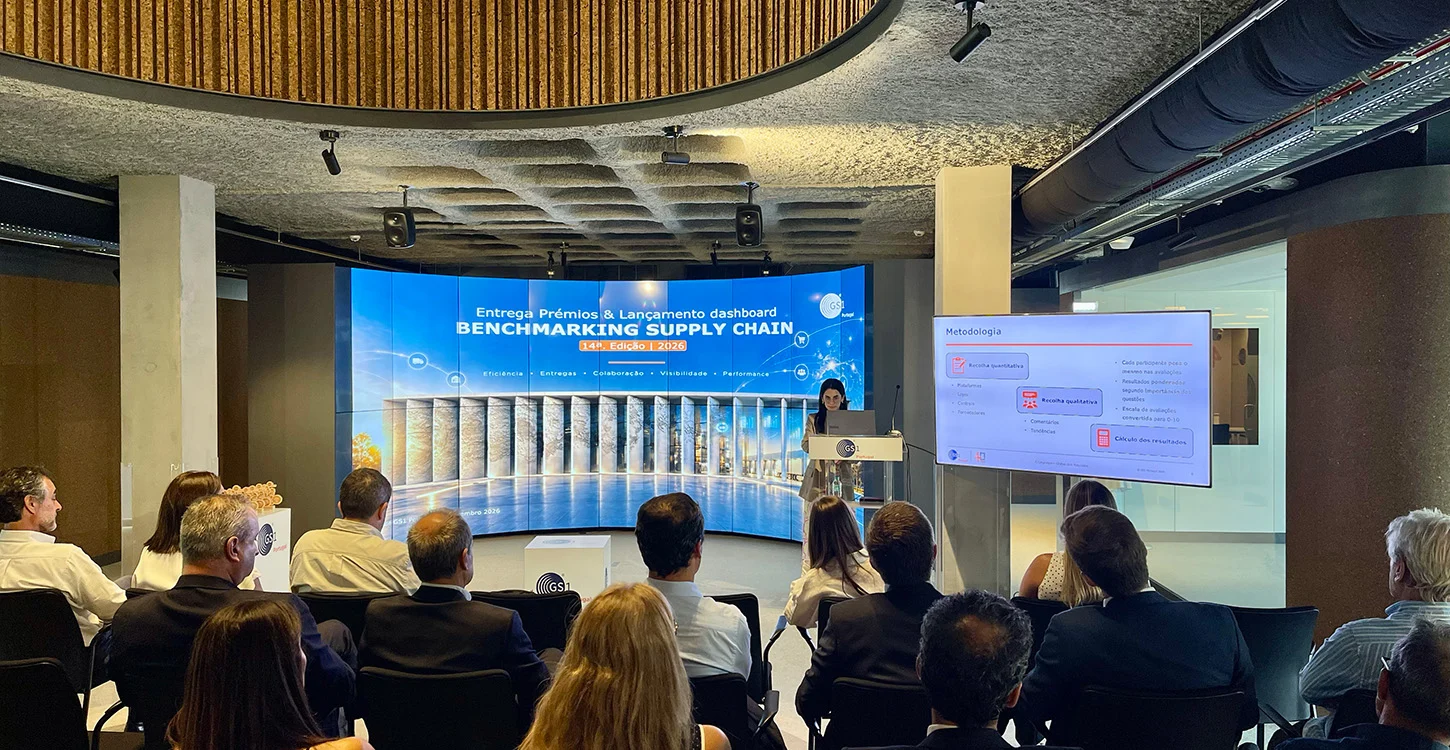
GS1 Portugal presented the results of the 14th edition of the Benchmarking Supply Chain on September 17th, in a session that brought together companies from across the consumer goods ecosystem. The event included the awarding of performance prizes and the presentation of its new dynamic dashboard, which will allow organizations to consult results and identify opportunities for improvement with greater autonomy, speed, and capacity for action.
Advertise with us!