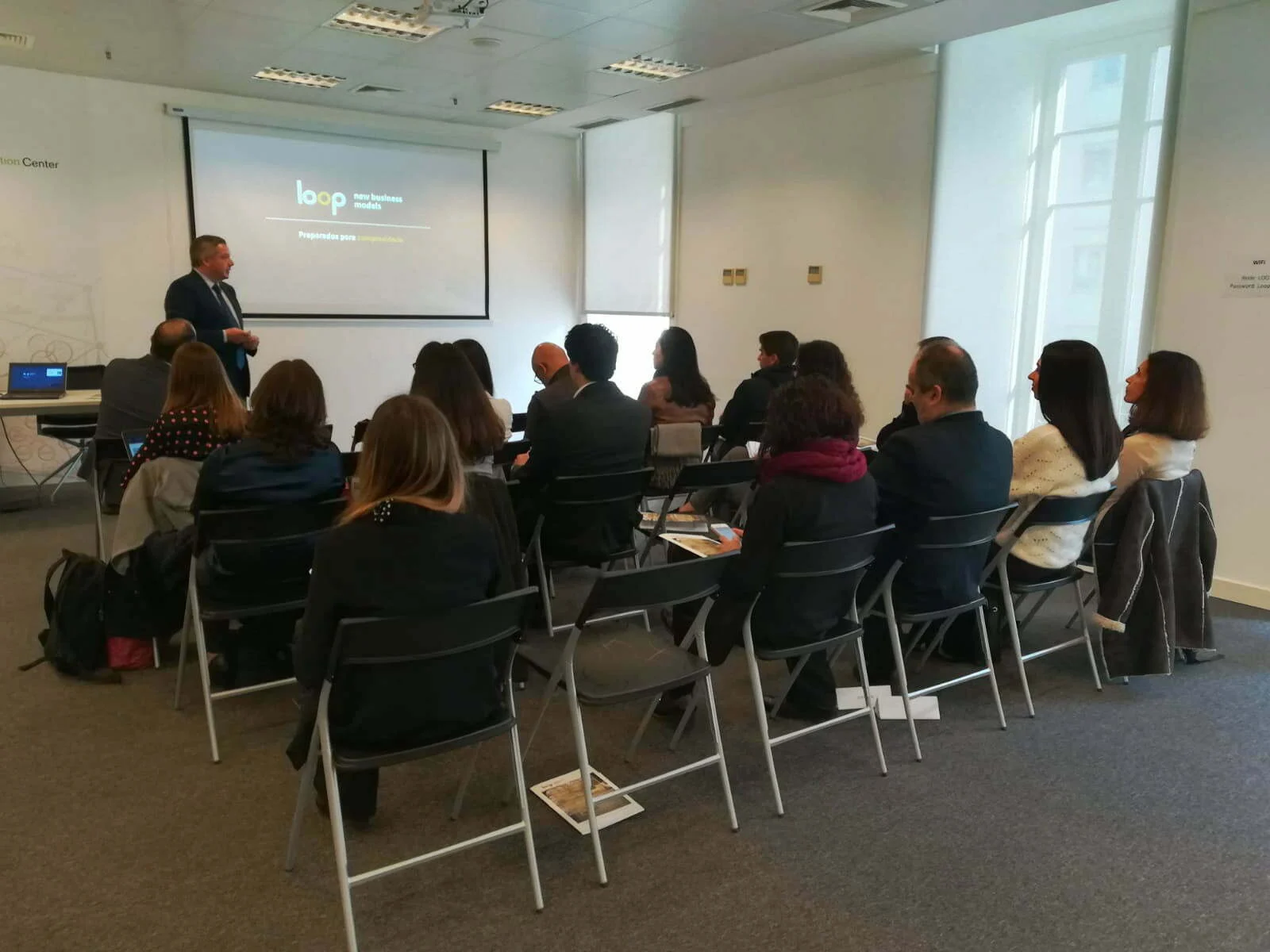
The strategic consulting firm Loop New Business Models presented, this Wednesday, February 6th, at its Strategic Reflection Center in Lisbon, the report "10 impactful trends in the sector". Grande Consumo applied to the business model in 2019”.
Two dozen executives from the FMCG, Food Retail, and Packaging sectors attended a meeting with Antonio Flores, CEO of Loop, as he discussed the technological, social, and market trends that will have the greatest impact on business models and force companies to rethink their strategies.
The first of these trends involves virtual and augmented reality and voice systems. The CEO of Loop shared the uncertainty of what will happen with the impulse of increasingly programmed purchases. In this vein, the contribution of consumer experiences, both from retailers and the manufacturing brand, is the challenge to improve and activate sales from the business model onwards, which inevitably involves strengthening the manufacturer-retailer relationship.
Another trend is related to servitization, the next step for brands. The contribution of services was presented as a great opportunity for brands to add value, broaden the experience and purchasing possibilities, a particularly relevant bet for commodities , and to prevent differentiation from being solely a matter of price.
Also noteworthy is the monetization of information in the face of the Big Data wave. Antonio Flores spoke of leveraging the ability to convert data and the enormous amount of information that brands possess, both from the market and the consumer, and converting it into services that expand the value-added offer for customers, contributing to increased loyalty, as well as broadening the experience and, therefore, the possibility of purchase and generating new revenue streams. “ In markets like retail, there are structured processes and information, but both in the independent Horeca channel and in the impulse channel, there is a lot of room for development and a great opportunity, for example, for manufacturers who have their own distribution network ,” highlighted Antonio Flores.
From a market perspective, several trends are also emerging to consider in 2019. First and foremost is the issue of sustainable production. Given the growing awareness of food waste, it was highlighted that the market is immersed in a contradiction: wanting fresh, natural products, without processing or additives, while simultaneously demanding longer expiration dates. " In this context, new business opportunities arise, for example, in high-pressure processing (HPP) models that increase the product's shelf life while preserving its properties and the benefits of the natural product ."
Another trend is reflected in the absence of packaging as a strategic value. Consumers are increasingly demanding and environmentally conscious, forcing manufacturers to make their packaging more sustainable, intelligent, safe, efficient, and productive. Faced with a global push to reduce plastic, meeting consumer preferences requires manufacturers to consider the packaging/no-packaging strategy as part of their value proposition.
Along the same lines, another trend to consider is the circular economy. It was mentioned that the opportunity for many companies lies in joining the wave that encourages the introduction of innovative business designs and models, which provide new business opportunities and broaden their scope, while simultaneously contributing to improved sustainability.
Loop's report also considers some trends from a societal perspective. Starting with product traceability and credibility, it offers the opportunity to provide a quality product where its origin, preservation process, packaging information, and distribution channels are evaluated as differentiating elements of the offering.
There is also room for growth in organic/eco-friendly products. Consumer demand is driving healthy eating, and eco-friendly products are growing at a much higher rate than the rest of the sector. In this context, investing in organic/eco-friendly products is not only a viable option for manufacturers but also for retailers, who have the opportunity to support their philosophy in this area.
Also noteworthy is the importance of "customer engagement" and how to adapt the business model to different consumer groups.
In conclusion, Antonio Flores emphasized that all the previous trends converge in the tenth, which also presents a great opportunity for companies in the fast-moving consumer goods sector: product superiority as a strategy to gain market share.
Given the urgent need to review the processes for launching new products/services, with the aim of finding new amortization formulas, Antonio Flores highlighted that strategic data analysis presents itself as the best guiding principle for establishing a product superiority strategy for brands that can be profitable and sustainable over time, achieving the perception that their products or services are far superior to the average and that they excel both in performance and in value/price ratio.
To achieve this, Antonio Flores shared the need to focus efforts on four ingredients. Starting with tracking and identifying the target audience, to achieve a real connection between brands and consumers, something that cannot be achieved through the product itself but through my philosophy and values as a manufacturer (real differentiation). The second aspect is the correct reading of the moment, necessary to, through a proactive attitude of seeking new areas of opportunity, identify the right moment to meet needs. The third ingredient relates to the philosophy of consumption and the definition of the brand's attributes and values that make it unique and differentiate it from the rest of the market. Finally, corporate governance, focused on designing organizational strategies that create collaborative and leadership environments open to the implementation of new ideas, the generation of open innovation, and the transfer of knowledge.
Watch the video summary of the trends here: