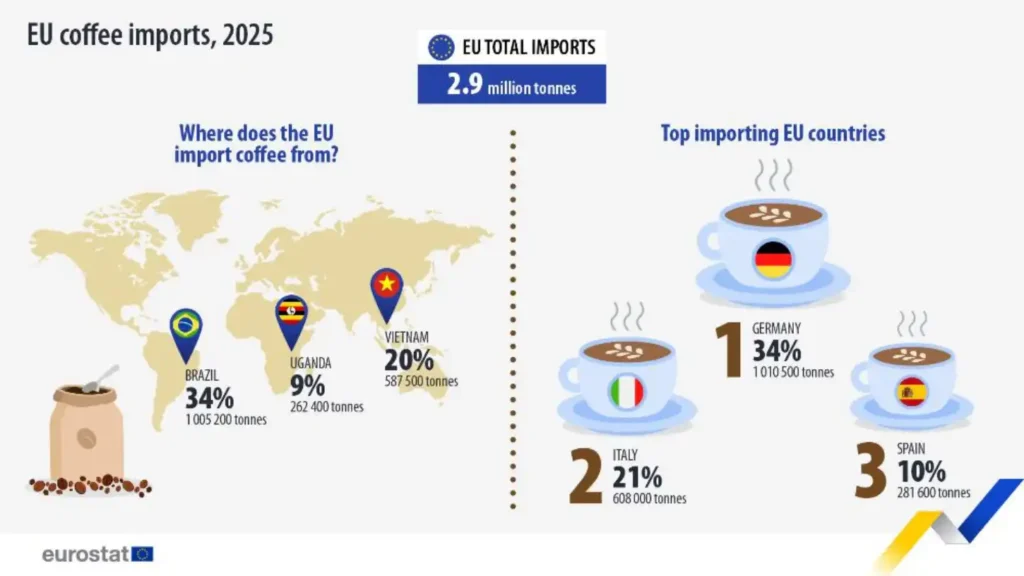
The European Union imported 2,9 million tons of coffee from third countries in 2025, a volume only slightly higher than the 2,7 million tons recorded in 2015, according to data released by Eurostat . In terms of value, the evolution was more significant: imports increased from €8,6 billion to €18,7 billion, more than doubling in a decade.
Brazil was the main supplier of coffee to the European Union, with 1,005 million tons, corresponding to 34% of extra-EU imports. Vietnam came in second place, with 587.500 tons (20%), followed by Uganda, with 262.400 tons (9%), Colombia, with 162.900 tons (6%), and Honduras, with 136.500 tons (5%).
Germany leads in imports.
Germany was the main destination for European coffee imports in 2025, with 1,01 million tons, equivalent to 34% of the total imported by the EU from third countries.
Italy comes in second place, with 608.000 tons (21%), followed by Spain, with 281.600 tons (10%), Belgium, with 269.200 tons (9%), and the Netherlands, with 216.600 tons (7%).
Together, these five countries accounted for more than 80% of non-EU coffee imports last year.
European production grows 12%
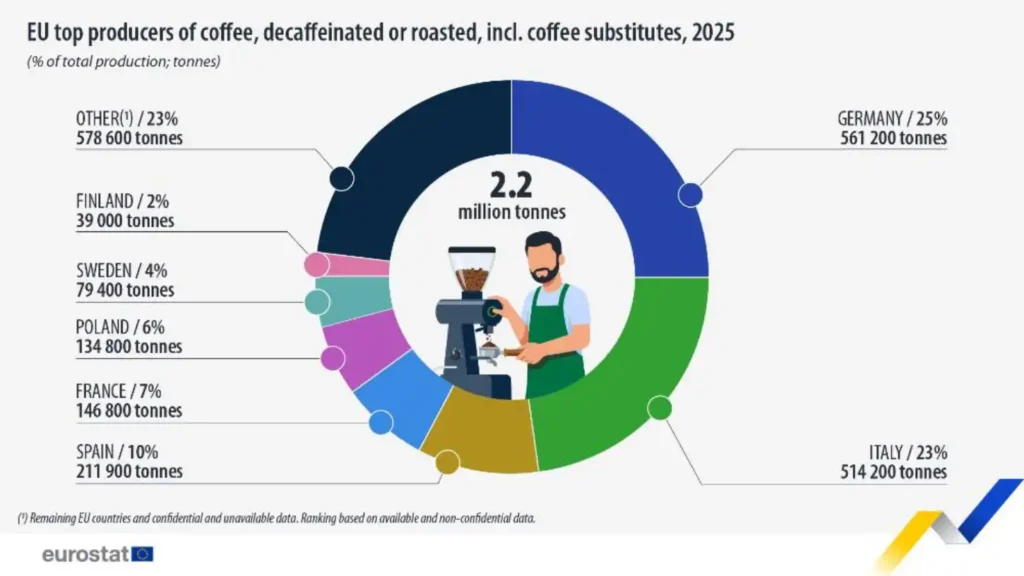
Despite relying on imports for its green coffee supply, the European Union has a significant processing industry. By 2025, EU countries will have produced more than 2,2 million tons of coffee, including roasted and decaffeinated coffee and coffee substitutes.
The volume represents a 12% increase compared to 2015, when production stood at 2 million tons. In terms of value, European coffee production is projected to reach nearly €19 billion in 2025.
Germany was also the leading European producer, with 561.200 tons, or 25% of the total production of EU countries that reported data. Italy came in second, with 514.200 tons (23%), followed by Spain, with 211.900 tons (10%).
France, with 146.800 tons (7%), Poland, with 134.800 tons (6%), Sweden, with 79.400 tons (4%), and Finland, with 39.000 tons (2%), complete the seven largest producers.
Together, these seven countries were responsible for 77% of the European Union's coffee production in 2025.
Advertise with us!